White People Sex Jazz No. 4: Female Fantasy & Shirtless Dudes in The Two Worlds of Jennie Logan

Dear Reader:

Let’s jump right in with The Two Worlds of Jennie Logan.

Set the scene, shall I? 

It’s Wednesday night, specifically October 31, 1979. Halloween. 9:00 P.M. Should you go to bed? Nah. The CBS Wednesday Night Movie is about to start. Ooohh, it’s The Two Worlds of Jennie Logan. Of course, that’s the adaptation of David L. Williams’ book Second Sight, a pretty solid read a couple years ago. Who’s in it, I wonder? Lindsay Wagner! The Bionic Woman! That’s all I need to hear, I AM IN!

Time to settle in for a straightforward romantic fantasy drama. I’m just finishing this brand new item on the McDonald’s menu, called a Happy Meal. I have my Ding Dong and my TAB Cola. My last remaining worries of the day are slipping away.

Wow, I hope that hostage crisis in Iran ends soon, it’s been over a year since those people have been heard from. This year has been bonkers so far – Pope John Paul II came to America, John Wayne died, those Harvey Milk riots in San Francisco, the one crazy Disco Demolition Night and so on. I hope Jimmy Carter can still win the upcoming election after that “Confidence” doozy.

10 was pretty good but When A Stranger Calls was kind of predictable. None of those other films matter though because Star Trek: The Motion Picture is going to blow us all away. But gas prices are at a super high 86¢ and tickets already cost $2.51! Damn energy crisis! One thing I know for sure though, man, my TV’s visual quality is so state-of-the-art.

>>> FULL MOVIE HERE <<<<

The Two Worlds of Jennie Logan opens with a close-up of a Victorian painting of a country home, and what I can only describe as an eerie synth cuckoo clock on the score. The painting fade transitions to the home today complete with an antenna on the roof, and is shown by a placard to be called the Reynolds House. It is up for sale.
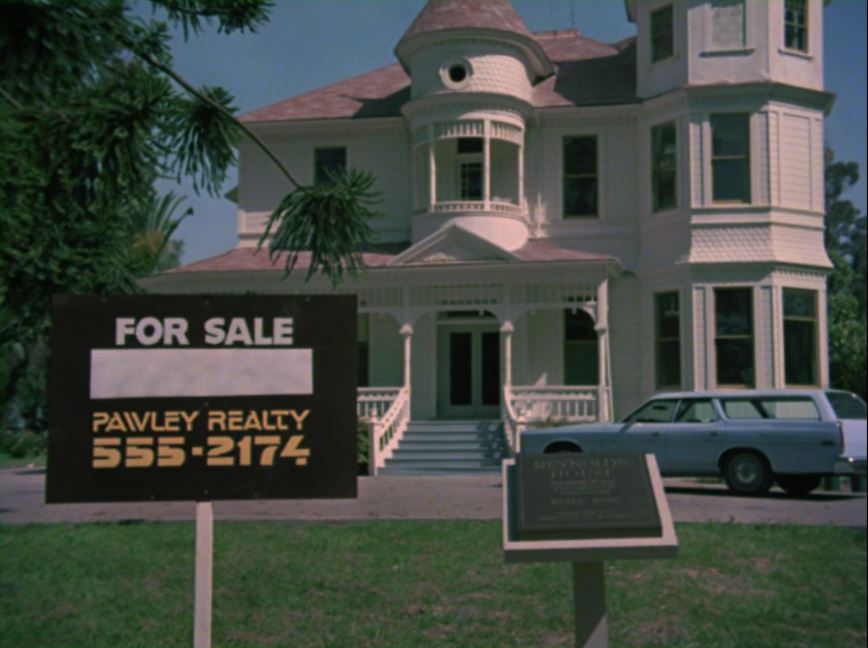
Related image

Touring the old home is a young married couple, Michael and Jennie Logan, who are guided by a real estate agent spouting on about history and legacy and death. Jennie is clearly in love with the house, while her doting husband Mike looks on lovingly at her excitement. She admires the antique cabinets before they all head upstairs.

As the agent leaves them alone to discuss what they think of the home, we get our first sign that all may not be well in the Logan marriage. Mike wants “things to be the way they were.” Jennie only wants the house if they both agree they want it together, especially since it would require an hour-long train commute everyday for Mike to get to work. Mike says he’d live in the Taj Mahal if she wanted to. That’s a tomb, Mike.

While Jennie laments all the attempts to modernize the home (i.e. central air, a fresh coat of paint), they both agree to purchase the home. Before heading downstairs, Jennie finds herself drawn to the attic but the agent warns her against investigating since it’s so old and untouched.

Related image

Cut to Mike washing his 70s brown car on the front lawn. Shirtless. Wearing tight jeans. He drinks from the hose like a dog. Jennie looks down from the upstairs window where she struggles to scrape away the house’s fresh coat of white paint. Suddenly, she has visions of her shirtless husband writhing in a bed with another woman.

Jennie is stirred from her reverie when she hears a sound come from the attic. Entering the realm of cobwebs, she discovers the attic’s porthole-window is slamming open and closed due to the wind. At the forefront of the room is a ghostly sheet draped over a mannequin. As Jennie explores the room, she is drawn to remove the sheet, which reveals a white Victorian dress with a hole in the shoulder.

Image result for two worlds of jennie logan

Jennie is unexpectedly spooked by Mike who’s followed her to the attic. Still shirtless. Stills 70s jacked as he flexes his arm to camera. Jennie exclaims that she found an heirloom. Mike goes in for a kiss but Jennie dodges him, which he brushes off. Jennie regrets hurting him so she calls him back so she can touch his bare chest during a hug.

Some time later, Jennie meets up with her friend Beverly in the city. According to Bev, the country agrees with Jennie – a romantic, a real throwback. The country girl goes onto reminisce about her favorite memories of staying with her grandparents on their Ohio farm.

Related image

Apparently, Jennie had been in a depressive slump for the past year as a result of . . . *you guessed it* . . . Mike’s infidelity. Jennie claims she never knew who the other woman was, but as he’s a professor, she suspected it might be one of his students. Bev calls them an occupational hazard. Yikes. Either way, Bev is eager to see the dress Jennie keeps raving about, even if it means missing out on another wild weekend on Fire Island with one of her many boyfriends.

By the time she returns home, Jennie’s had the dress fitted and shoulder mended, so she can just like wear it around her house? The first time she dons the dress, things feel odd. But she descends to the living room to show Mike, who’s occupying the couch with his Budweiser and watching the basketball game. He remarks how lovely she looks then trains his eyes back to the screen.
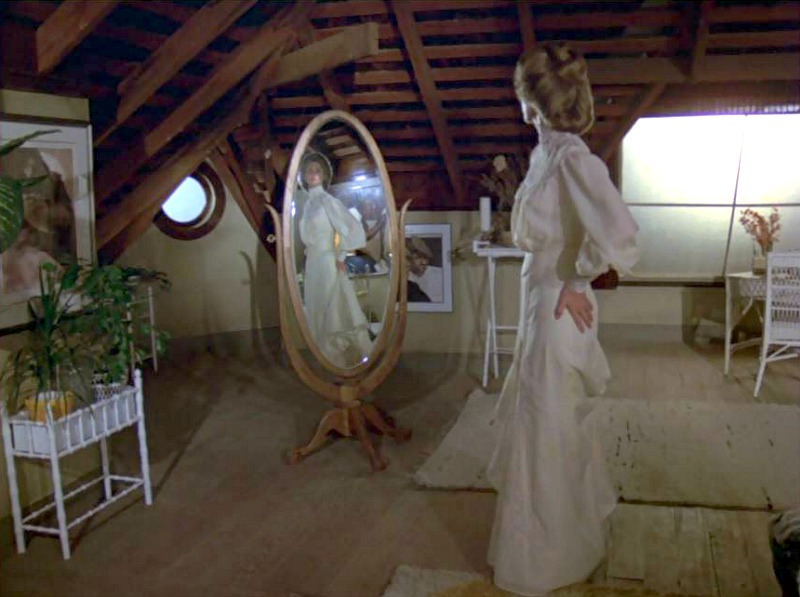
Image result for two worlds of jennie logan

While Jennie wants Mike to dance with her (flowy skirts do that to a girl apparently), he’s basically like “Bitch, wait ‘til halftime.” Mike gets upset that Jennie’s blocking the TV set. They argue. She brushes it off and returns to the attic. While looking sadly through the porthole, she suffers a sudden and debilitating migraine and blacks out.
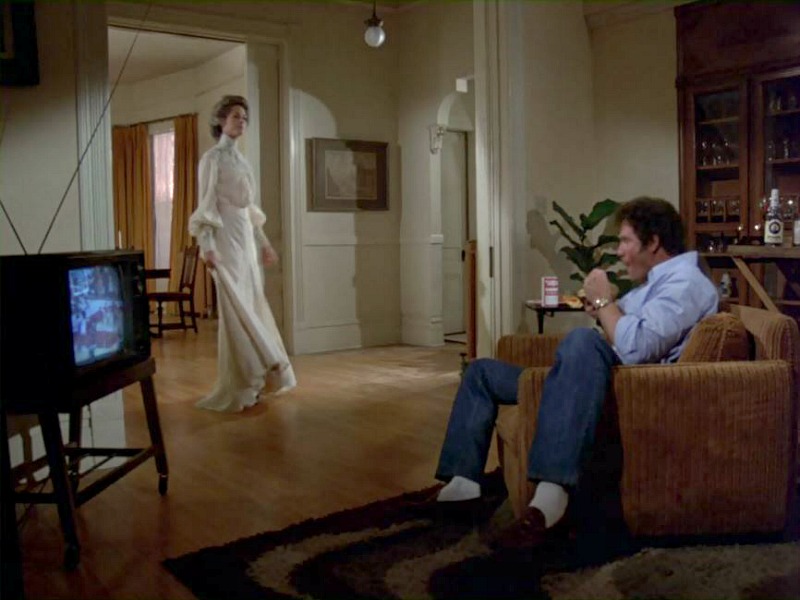
Image result for two worlds of jennie logan

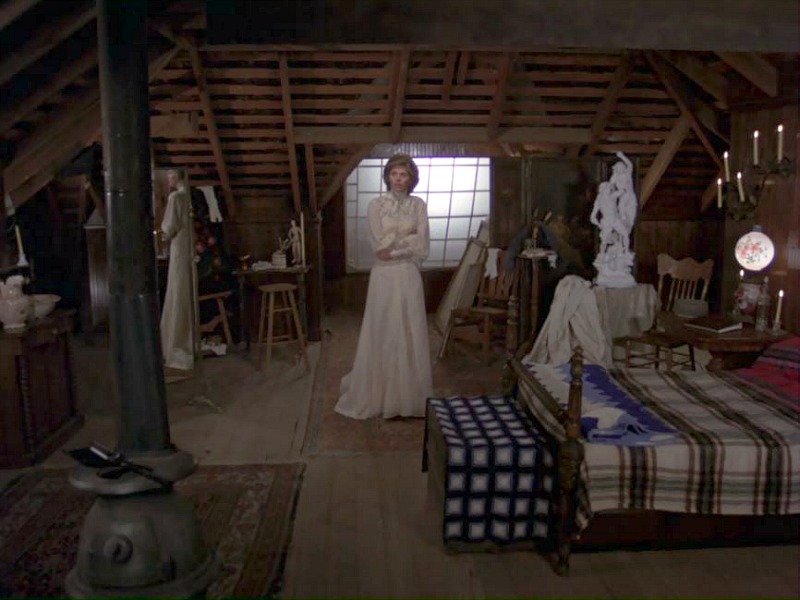
Jennie awakes in the attic, but it’s not her attic. Antiques, art supplies, and candles have replaced electric lights and her expressionist paintings. She suddenly hears a violent argument occurring downstairs between an old man and a much younger man over some woman named Pamela. Shocked and scared, Jennie opens her eyes to see she’s returned to her attic.
Related image

Immediately removing the dress, a very shaken Jennie seeks comfort from her husband. Mike presumes it was all a dream concocted from her vintage obsession – a combination of the house and the dress – so she’s obviously “got old on the brain.”

Later that night, Jennie and Mike hear the sound of breaking glass originating from downstairs. Corny mood music accompanies a shirtless Mike as he leaves to investigate. Somehow, the antique cabinet Jennie admired has been broken as though someone threw something through it. All the glass is on the inside of the cabinet, Mike notices before going to clean it up. He makes her laugh by playing with the garbage can lid.
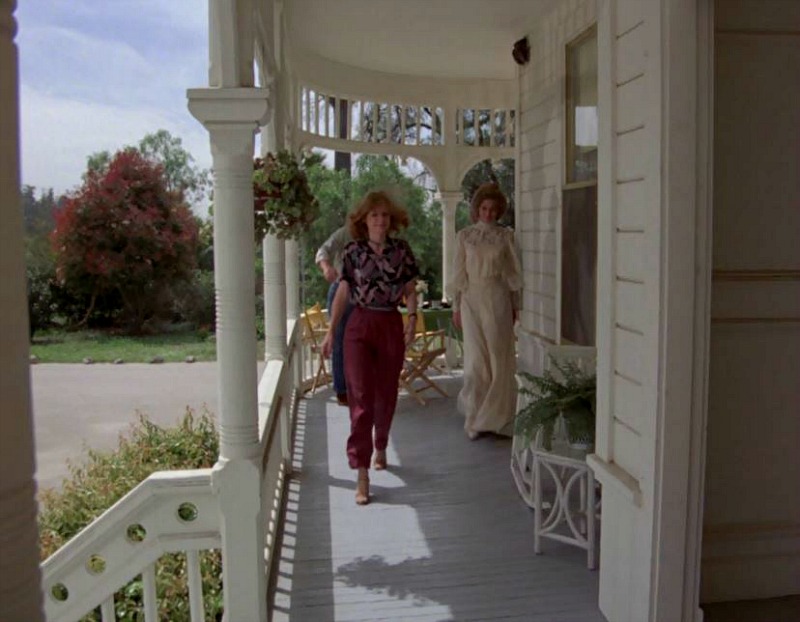
Bev and her boyfriend Don visit the country manor. They like it but think that it might be haunted by a poltergeist. Out of nowhere, Bev drops the knowledge that there’s a “theory” that the past, present, and future exist simultaneously, and if you can figure it out, a person can travel between them.

The men laugh off the theory. Don thinks the whole country is going insane with its spiritual and supernatural fascination, i.e. reincarnation, exorcisms, etc. Mike responds with a simple, “Right on.” Continuing to be an asshole, Don belittles Bev and her intelligence.

The foursome decide to go for a walk. Everyone, wearing 70s clothing, go ahead while the Victorian-clad heroine stays behind to get her hat. As Jennie jogs to catch up with them, she has another migraine while crossing the street. She grips the wooden pole of a power line for support but comes to leaning against a tree. There’s no paved street in sight, only dirt roads.

Down one such road, Jennie spies a man in a carriage who starts to scream “Pamela” and speeds towards her. He is 3/4 shirtless. Frightened, Jennie runs but falls on her face in the dirt road. She awakes face first on the paved street where Mike finds her, hysterical.

Later that evening, Mike makes a move on Jennie but she has another vision of him cheating. She pushes him away, but Mike persists to question whether things will ever be as before – “I put my hand in the cookie jar and I got caught.”
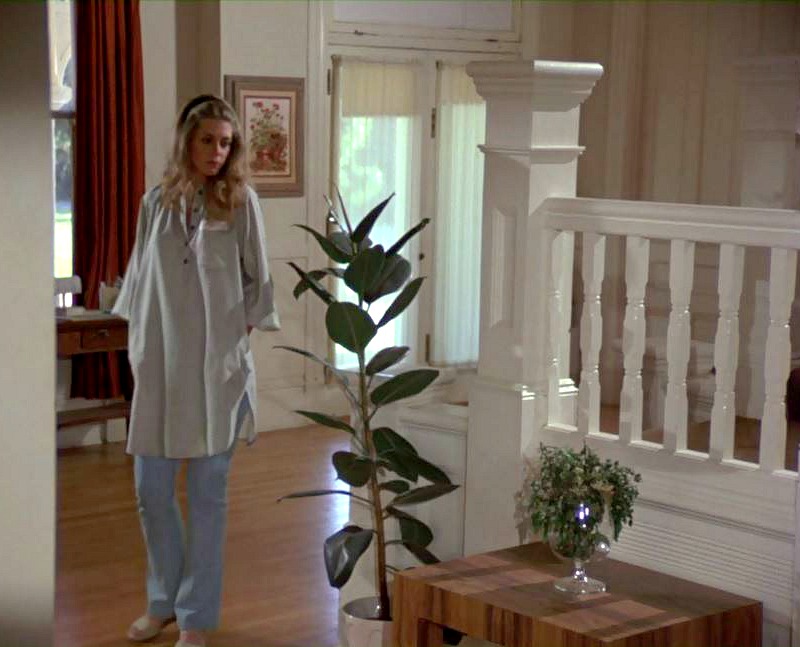
Jennie lays it out for him. Mike broke her trust and words aren’t going to fix it. The fact that he claims the sex meant nothing to him makes it worse for her somehow, because to her, that means he sees intimacy as temporary and easily transferable.

Because she’s forgiven him for the act itself and believes in the institution of marriage, Jennie wants it to work. However, anytime they have sex, she can’t help but believe that it’s never about love for him but just the physical. Mike agrees to be more patient.

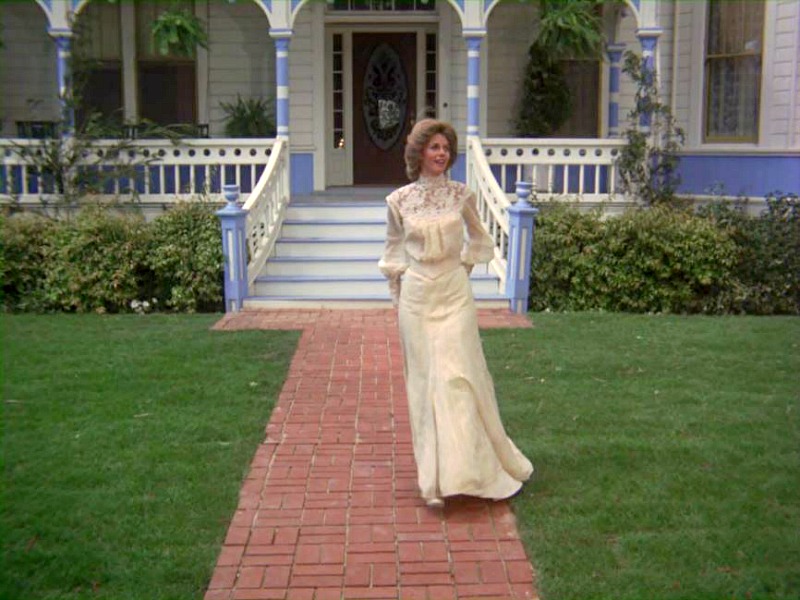
Meanwhile, Jennie finds herself back in the attic and wearing the dress now that Mike’s left for work. In her driveway, Jennie’s gripped by another migraine and awakes to the manor as it once was – flowers, vibrant blue exterior, white picket gate, and dirt roads. Again she sees the mysterious man, this time on a row boat in the middle of a lake with his dog.
Related image

Sneaking closer, the dog spots her. The man is 3/4 shirtless and begins to scream “Pamela! I love you! Stay!” He attempts to row to shore to catch her but is restricted by his tight pants. Jennie makes it back to the road where she almost gets crushed by a horse, i.e. run over by a car.

Jennie and Mike return to the city so she can see a psychiatrist. Dr. Lauren recommends that Mike continue to be a good, supportive husband until they know more information about Jennie’s issues.

Undeterred, Jennie goes to the local historical society to find out more about the house. Turns out the oldest citizen of the town is over 100 years old and is known affectionately as “Aunt Betty.” The head of the society, Mrs. Bates, relays that an artist once lived in the house but died young. He married into one of the town’s oldest families. His bride, Pamela, was killed the day of the wedding by some rogue horses.

Related image

The artist’s name was David Reynolds. He claimed to have seen the ghost of his bride near his home but she always disappeared. Everyone thought he was mad, especially after he took up with another woman so soon after. The night of the town’s turn-of-the-century celebration, David was murdered mysteriously via a gunshot wound, either by his bitter father-in-law Mr. Harrington or his unknown lover.

Only one of his paintings survived. When the original is revealed, Jennie realizes the subject is the spitting image of her in the dress she found. Jennie is shocked.

Related image

This time, Mike lays it out for her. He sees all of this as a massive coincidence because reincarnation is bunk. Furthermore, he thinks she’s crazy and has created this ideal man in her mind to punish him. Mike finally asserts that even though he wants her to be well again, she can’t keep fleeing from reality.

Dr. Lauren, the psychiatrist, concurs and sees the dress as the subconscious trigger that prevents Jennie from moving on with her life and accepting the reality. 35 minutes in and Jennie’s already like “What is reality?” She and the doc disagree over the latter’s suggestion to destroy the dress.
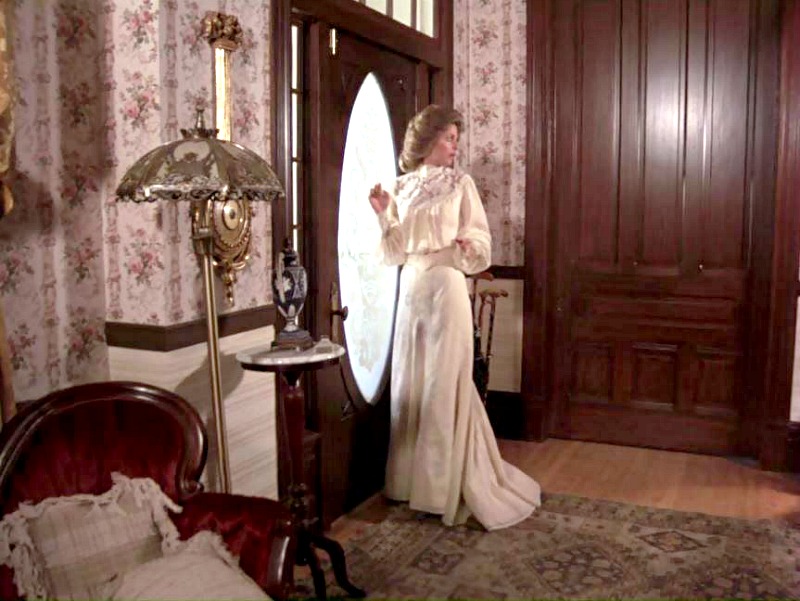
Cut to the Reynolds House. You know the routine. Jennie. Dress. Migraine. Back in time we go. She finds David in the front yard, this time only 1/2 shirtless. He is sawing some wood quite intensely. Jennie calls to him and with a quick zoom to his face, he is again calling out for “Pamela.” David’s already out of breath by the time he realizes Jennie and Pamela are not the same person.

Tight pants and ass to camera, David offers her some refreshments if she comes inside. When Jennie notices the broken cabinet, David admits to causing the damage in a moment of grief and rage. To be honest, David is channeling some major William Shatner vibes in his delivery. He’s glad that she’s come and so is she.
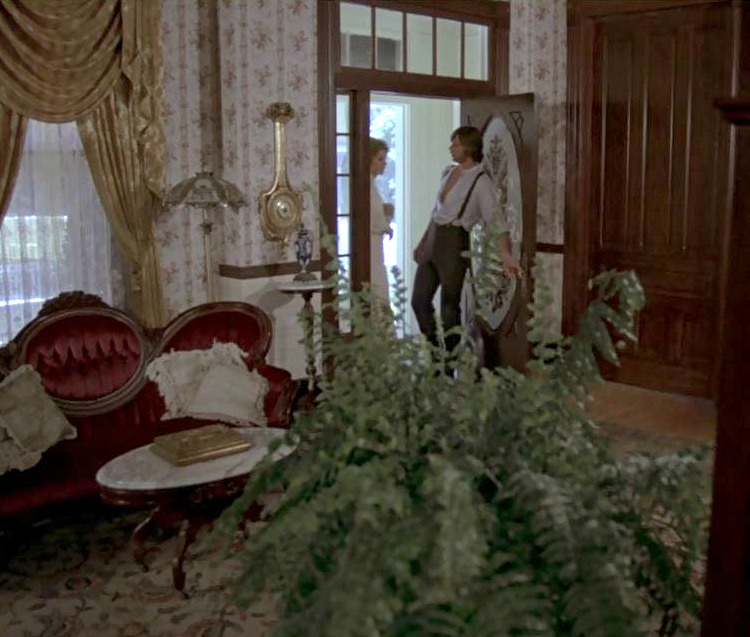
Image result for two worlds of jennie logan

Next thing Jennie knows, a carriage rolls up on the house and David pulls out a rifle and starts shooting at it. Apparently, the carriage dwellers are detectives hired by Mr. Harrington who thinks David married/murdered Pamela for her inheritance.

More than a little disturbed, Jennie decides she wants to go home. She states very clearly that she must go alone. David flips/whooshes his hair and picks her some flowers. Jennie awakes in the present still carrying the bouquet. Returning home, she gazes longingly at her flowers. Mike notices and is perturbed. That night, an again shirtless Mike enters the bedroom with the hopes of getting down. Jennie instead is deep in sleep, while a single tear escapes her eye.

Image result for two worlds of jennie logan

Jennie continues to travel back in time to see David. This visit, she finds him sitting on his lawn sketching with his dog, Old Napoleon. Uh-oh, Pamela’s older sister Elizabeth shows up because even though she wants to fuck David, she still brought her BF to have an awkward picnic together. Tension builds. Turns out she used to be David’s model before Pamela entered the picture. Pun unintended. They leave after lunch.

Jennie lets David know that Elizabeth is straight-up down to get that. David reassures her that whatever was there was unrequited on his part. However, he does confess that Elizabeth has good reason to be jealous of Jennie, who then agrees to return the next day so he can sketch her.

Related image

Jennie lets it drop that she’s actually married. Initially, David is upset but decides to use his words to work out that he’s interested in Jennie for herself not the superficial resemblance to Pamela – “God forgive me, you’ve made me forget her.” Caressing her face, he goes on to declare that there’s “something magical” about her, as though he’s known and loved her for years. P.D.A on the Victorian front lawn, ya’ll.

Papa Harrington shows up at the worst time to condemn David’s lack of public grief or discretion. He further warns David against chatting up Elizabeth, and “until the wheels of justice put a proper end to [his] villainy,” Papa Harrington will always be there. Victorian death threats, classy and to-the-point.

The death threats keep Jennie up worrying well into the evening. In the wee hours of the late night, she is finally compelled to search her trash can for the cabinet’s broken glass . . . so she can kiss the shards like a crazy person. Mike catches her, and is like “Bitch, that’s fucking weird.”

He claims he wants to help her but Jennie retorts that his “help” means consistently trying to convince her that she’s crazy. She admits to going back in time to meet David, while Mike protests that he can’t compete with imaginary men. Jennie brings up the cheating. Oh no, marriage spat turned argument is in full effect.

Mike thinks a vacation will do them good but she doesn’t want to go anywhere with him. Well, why not go to Fire Island for a week to get away from the house and hang out with Bev. Jennie apologizes for the outbursts and agrees to the Fire Island idea.

Nope, she’s just lying to Mike and going back in time instead, so David can “sketch” her. All it takes is a fair day of parasols, boat rides, comedic tumbles into the water, and mutual “fuck me eyes” and Jennie. Is. Ready. Still afraid to remove her dress for fear of being sent back to the present, she’s cautious. No worries though, she’s firmly planted in 1899. Dress or no dress.
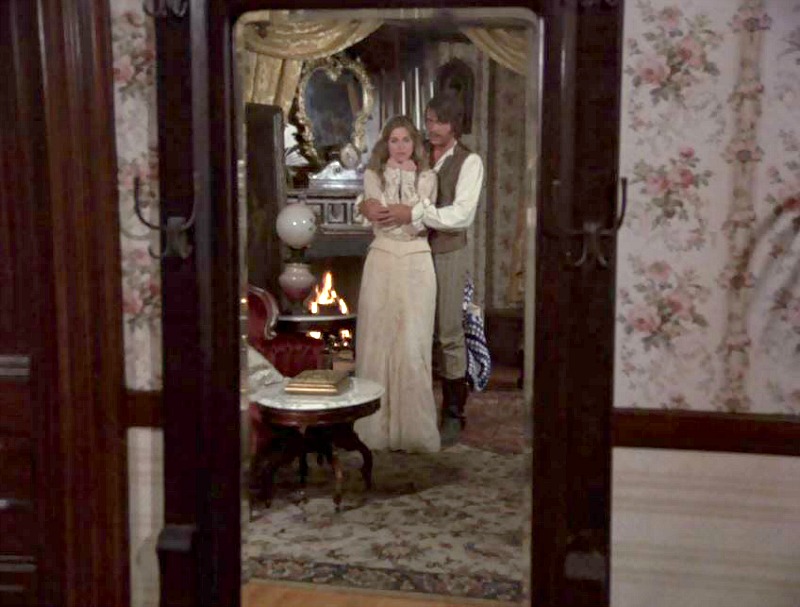
Image result for two worlds of jennie logan

David and Jennie apparently bone off-screen. Fireside, she helps him light his pipe, which is not a euphemism. He’s fully shirtless and doesn’t seem to mind that she has a husband.

The next day, Jennie returns to the historical society to learn about a potential duel that may have killed David, according to town rumor. One of the employees even shows her Papa Harrington’s antique pistols, which due to the technology of the time, were very unreliable. Jennie is then allowed to talk to the town centenarian “Aunt Betty.”

Now, I’m not gonna mince words here, Aunt Betty’s make-up job makes her look like a fucking monster. Ok, moving on. Jennie and Aunt Betty have a moment but the latter feigns illness before any new information can be learned.

Meanwhile, Jennie is extraordinarily good at pretending to love her husband. The “loving” couple go window-shopping and he buys her a hand-painted locket. Together fireside, Mike mournfully reminisces about their life before he cheated. Either way, Jennie can’t seem to focus on the present.

image

Mike lights his pipe. Jennie stares at the pipe. Rather curtly, Mike asks whether “He has a pipe?” They fight over David yet again. He accurately accuses her of not caring about him or their marriage, especially since they haven’t gotten down in quite a long time. Jennie apologizes for hurting him again and starts to sleep in the attic.

No longer sharing the marital bed, Jennie is plagued by nightmares of the impending duel. She awakes in David’s arms. Ooohhhh, so she isn’t sleeping in the attic to avoid Mike but to be alone so she can go back to David! Reminder, Jennie continues to wear her wedding ring throughout all of this.
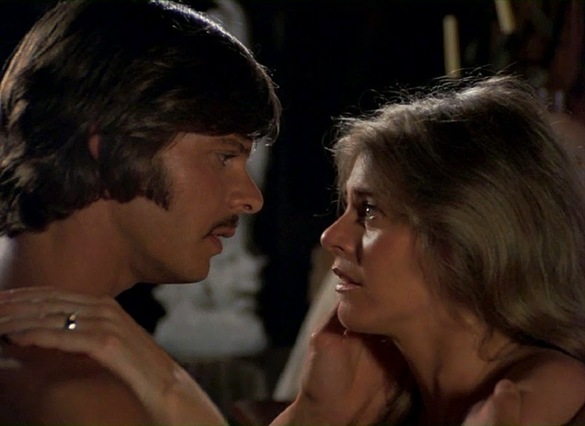
Related image

Jennie asks David if he believes in life after death. He gives her the typical artist’s answer, that the act of making art gives him the feeling of godliness, and spiritual transcendence, the same feeling he gets when he’s getting down with Jennie. That he’s immortal. How very Hemingway of him. David, who’s kind of ripped, reveals his painting of her, the one that now hangs in the town’s historical society.
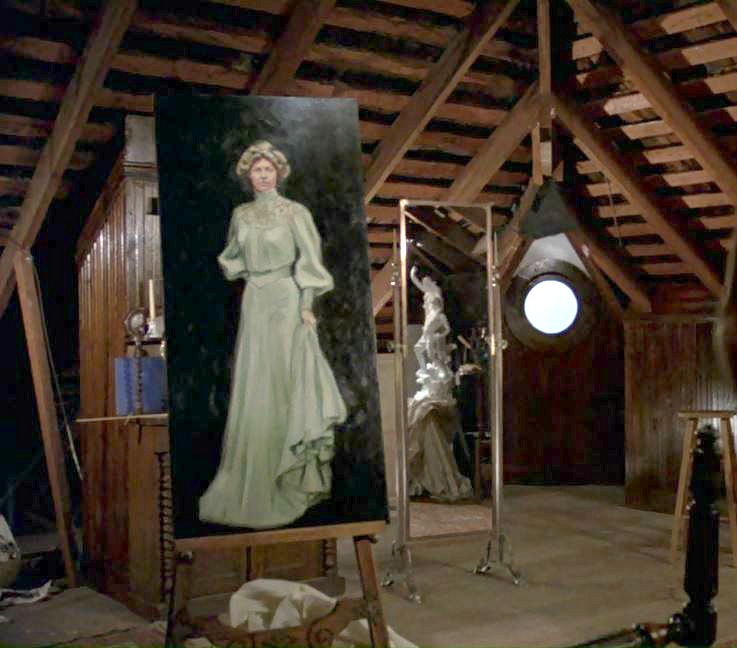
Image result for two worlds of jennie logan

David begs Jennie to leave her husband and go with him to Europe, because “I need you more than he does.” Damn, David. She agrees as long as they can leave before the turn-of-the-century celebration. Elizabeth inconveniently stops by, covertly smells David’s pipe. Again, not a euphemism. David, 3/4 shirtless again, confronts her downstairs. She makes a move before seeing a robe-clad Jennie also descend the stairs.

Oh no, Papa Harrington also entered the scene. No locked doors apparently. He commands Elizabeth to leave and then challenges David to a duel.

Returning to the present, Jennie has a painful conversation with Mike. She proceeds to go on for a very long time about how much she loves David, wants to be with him, have his children, and never return to her own time. Like just rubs it in his face. However, she does promise to let Mike know somehow that she’s happy despite the barrier of time.

The night of the celebration Jennie breaks into Papa Harrington’s house to tamper with the duel pistols. She hears him dressing for that night’s celebration, and he seems to hate his own daughter.

Image result for two worlds of jennie logan

At the ball, David is fully clothed for the first time, Victorian ruffle-front shirt and all. Buttoned all the way up if you can believe it. He awaits Jennie’s arrival to the party, which an incensed Elizabeth spots. Her BF is there too. His name is Edward, in case you weren’t wondering. Jennie and David dance, and really push the Victorian limit on P.D.A.

Suddenly, Jennie recalls that the two primary rumors surrounding David’s death are the duel and the presence of a mysterious woman, i.e. her. So she books it and leaves him standing on the dance floor. Returning to the present, Jennie receives a call from the historical society. Aunt Betty would like to speak to her. Turns out . . . *twist* . . . she’s Elizabeth Harrington. And she was the one who murdered David, waiting in the bushes with her gun during the duel.

Apparently, she confessed her feelings to David, who then savagely rejected her. Elizabeth now speaks to Jennie as though she knows her (because she does), causing Mrs. Bates great confusion. Jennie rushes home to save David. But oh no, Mike is home, furious, betrayed, drunk, and holding the time-traveling dress hostage. Jennie tears the dress away and runs to the attic, causing the rip she saw when she first discovered the dress.

Mike, incensed, stomps over to the attic and threatens to break down the door and burn the dress. Too late, Jennie has fled to the past to save David. In the empty field where the duel has commenced, David shoots into the ground then drops his weapon. Unable to shoot an unarmed man, Papa Harrington surrenders the duel. Just then, Elizabeth emerges from the bushes with her gun drawn, but Jennies rushes towards her. A single gunshot rings out.

Image result for two worlds of jennie logan

Mike finally succeeds in breaking down the attic door, where he finds a perfectly still Jennie laid upon the bed. After realizing that she’s not fucking with him, he touches her cold skin. Jennie Logan, 1979, is dead. Lindsay Wagner, though, is definitely still breathing. Mike mourns over her dead body, followed by a quick and somber funeral.

Mike moves out of the Reynolds House. Can’t exactly blame him. While reminiscing in the attic, he notices the tear in Jennie’s dress. But surprise surprise! One of the movers discovers antique paintings hidden behind a wall. The numerous artworks show Jennie’s and David’s wedding, her honeymoon in Paris, the birth of her first child, her growing family, and finally, an image of Jennie in old age. David, the presumed artist, is not present. In each progression, she is wearing the hand-painted locket Mike bought for her.

Realizing that Jennie was right the whole time and lived a happy life, Mike tears up, sad but joyful. The End.

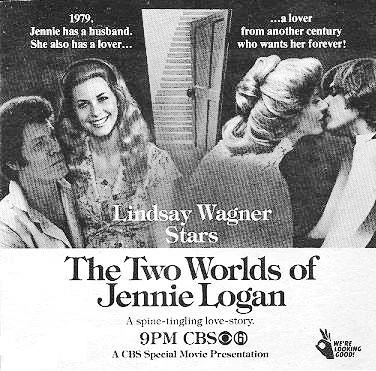
NOW, The Two Worlds of Jennie Logan is actually a pretty solid film. Well-executed concept, technical competency, and convincing production design. Probably the most intriguing element of the film is the absolute dedication to the objectification of male characters as part of the hetero-female fantasy. Hence, why I mentioned every single time Mike or David was in a state of undress or sexualized via the camerawork or costume design. Truly fascinating. Unfortunately, no white people sex jazz in earshot.

Obviously, the film is not perfect beyond the expected corniness and cheesiness. No character is left unscathed. Mike cheated on Jennie, seems to measure the state of his marriage by quantity of boning, and potentially exploited an unequal power dynamic to have sex with a student. David moves on from Pamela’s death incredibly fast, has no problem cavorting with a married woman, and cruelly rejects Elizabeth (who happens to be an attempted murderer). And oh dear lord, Jennie! She cheats on her husband, flaunts it openly and brutally, and still tries to claim the high ground.
Related image

Of course the film also engages in thoughtless nostalgia for the Victorian era. You know, a time when being anything other than a wealthy, white straight man was just shit. Female-oriented fantasy thrives in that gray area of chivalrous nostalgia.

Please watch this film, IT IS SO MUCH BETTER! Also, legal purchase is recommended. Support good movies!

Furthermore, if we’re being honest, we both know the best version of this story came out almost one year after Jennie LoganSomewhere in Time (1980). Time travel. Victorian setting. Romance. Even mental projection to the past via a theory of contemporaneous timelines. Based on the novel Bid Time Return by Richard Matheson, published in 1975, two years before the book Jennie Logan is based upon. Coincidence?

Well, that about does it. Tune in soon for more of that . . .

White People Sex Jazz!

White People Sex Jazz No. 3: Groovy Ladies & Sexual Bigots in The Feminist and the Fuzz

Dear Reader:

Let’s jump right in with The Feminist and the Fuzz.

Set the scene, shall I? 

It’s Tuesday night, specifically January 26, 1971. You’ve just finished your weekly episode of The Mod Squad with the lovely Peggy Lipton. 8:30 P.M. Should you go to bed? Nah. The ABC Movie of the Week is about to start. Plus, Marcus Welby, M.D. is on right after. Ooohh, it’s The Feminist and the Fuzz. Quite the title. Who’s in it, I wonder? Barbara Eden! That’s right, I Dream of Jeannie has just ended after so many years. David Hartman? He has such a stentorian presence like a host of a popular American morning talk show.

Time to settle in for a straightforward romantic comedy. I have my Ding Dong and my TAB Cola. My last remaining worries of the day are slipping away.

Wow, I hope that crazy Manson Family goes to prison for the grisly Tate-LaBianca murders. I’m sure President Nixon’s a shoe-in for the next election. Should I go see Love Story or The Aristocats again? But gas prices are at a super high 40¢ and tickets already cost $1.50! Or, should I stay home and watch that new laugh-out-loud sitcom All in the Family? One thing I know for sure though, man, my TV’s visual quality is so state-of-the-art.

Image result for eve cigarettes

And, I’m excited to smoke my new pack of EVE cigarettes during the movie, especially since they told me it’s “Every inch a lady.” Finally a cigarette as pretty as me. *cough, cough, cough* So smooth.

>>> FULL MOVIE HERE <<<<

The Feminist and the Fuzz opens with a jazzy beat to follow a police car driving through San Francisco. One of the vehicle’s occupants, Officer Jerry Frazer, is looking through a newspaper for an affordable apartment since his building’s going to be torn down, which is proving to be a difficult task. You might say he’s a less-polished Donald Sutherland. After a car accident, Jerry questions a man about his bong but finds himself more interested in the apartment the victim’s just been evicted from for being a hippy.

Image result for the feminist and the fuzz

Meanwhile, Dr. Jane Bowers is having trouble with a patient, a stubborn little boy who proceeds to bite her. A colleague, Dr. Howard Lassiter, offers to help but then gives her a tip on that same apartment in exchange for a dinner date. Jane brushes him off, but Dr. Howard proclaims that he sees “a beautiful women in the women’s liberation movement as a challenge.” Jane counters that it’s men like him that the women’s lib movement is all about.

Jane and Jerry separately rush to see the free apartment. Jerry notices that she’s run a red light so he stops her, demanding to see her paper driver’s license. He lets her off with a warning because he really wants to nab that apartment. Jane protests that he didn’t give her a ticket because she’s a pretty white woman. The on-duty officer blurts out this gem of a line:

“Doctor, with your looks, if you don’t want any special treatment from men, I think you’d better enter a convent. Now, if you wanna believe I was corrupted by your beauty, go right ahead. I’m a corrupt cop.”

– Officer Jerry Frazer

Jane calls him a “sexual bigot.” Jerry demands she spread eagle against her car, then has a passing elderly woman search Jane for weapons/bulges while she squirms and screams. The woman says while she couldn’t find any weapons, Jane did indeed have many bulges.

Image result for the feminist and the fuzz

Afterwards, Jane and Jerry rush into the building. The landlord thinks they’re married. He shows them the apartment which has been trashed by the hippies, and the landlord exits the room with a shopping cart. Jane is embarrassed by the assumption of marriage. Jerry thinks she’s humiliated by the institution of marriage itself probably.

While leaving to discuss who should have the apartment, Jerry impulsively yells they’ll take it after he sees another woman eyeing it. Jane gives their married name as her own – welcome Mr. and Mrs. Bowers.

They sit at an outdoor cafe, where he upsets her by ordering for her without asking. He asks if she’s ever seen how beautiful Gettysburg is. She responds with “You don’t talk much like a cop.” He strikes back with “You don’t look much like a doctor.” Jerry asserts that it’s impossible to see her as anything but a woman because of those aforementioned “bulges.” Jane storms out.

Jane and Jerry then try to make the choice on the basis of need, followed by flipping a penny, which a kid steals. Jerry wins the coin toss but the kid is snappy against cops. Jerry refuses to take the apartment: “Ladies first, that’s just the way I was taught . . . I don’t understand you women’s lib . . . you’re just weaker.” Jane proudly proclaims her suffragette ancestry that gives her her feminist leanings. She won’t take the apartment if he’s giving it to her just because she’s a woman.

Both decide neither should have it. But then Jane proposes they share the apartment. Jerry is confounded by the proposal. Jane sees the potential though as she works all day at the hospital while he works the night shift and is also going to law school. Jane calls him predictable for potentially assuming that it meant she wanted to sleep together – “Can’t you think of any woman not as a sex object?” Jerry understands it as separate but equal. Jane can’t believe she’s just agreed to share an apartment with “a cop lawyer sexual bigot boy scout.”

Image result for the feminist and the fuzz

Jane returns to a hospital in chaos. Her friend Dr. Debby Inglefinger is fighting with the louse Dr. Howard over whether a 9-year-old female patient actually has asthma or if the symptoms are psychosomatic resulting from a feminine identity crisis. Debby calls out Howard for thinking most women don’t have identities. He denounces her as “a living, breathing argument for female slavery.” Debby calls him sexist, he calls her sexless and storms off.

Debby goes to calm down in Jane’s office. Jane reveals that Dr. Howard was the one who helped her get her apartment, as well as what he expected in return, what Debby refers to as a “couple kisses and a good mauling.” Turns out she’s in a militant radical feminist group called W.A.M, or Women Against Men.

Jane is moving into their new apartment when she brings by her fiancé Wyatt Foley, a liberal civil rights lawyer. Jerry, for fear of being caught by Wyatt, hides and sneaks around the house, finally ending up on the fire escape. No worries though, Jane’s already told Wyatt who is totally cool with the arrangement. He claims that he doesn’t have any room to judge or pass approval over Jane’s life. Guess he sees Jane as a real person. Also, Wyatt lives with his mother, a “very groovy lady.”

Unfortunately, Jerry hasn’t been so forthcoming with his own girlfriend, Kitty Murdoch, the radiant Farrah Fawcett. Realizing he hasn’t informed her of the arrangement, Jane calls Jerry a “chest-beating hysterically masculine gorilla.” Jane agrees to pretend like they don’t know each other.

Kitty gives Jerry a portrait of her in her Playboy Bunny outfit to hang over his bed. She’s eager to see his messy apartment so she can clean it and embrace all the gestures of domesticity (“girly stuff”). However, he’s able to get her out before she notices anything amiss.

Later that night, Jane and Jerry are typing out a written agreement and schedule for their living arrangement. Despite having told her fiancé, Jane remains mum on telling her father. When the phone rings, neither know who should answer based on who it might be. Jane, clad in her moo-moo, picks up the phone and puts on an unknown accent (Chinese?) and claims to be an answering service.

Over the next several weeks, they live solitary lives in the apartment, following a strict schedule and using a bell in the bathroom to make sure they don’t run into each other. Debby and W.A.M. take Jane to a self-defense class where all the female members have black belts. Meanwhile, Jerry picks up a familiar face for solicitation, a young woman named Lilah McGuiness, played by the incomparable Julie Newmar.

Jane and Jerry’s lives start to collide through a series of mishaps. One morning, Jane blows a fuse when she’s using her iron, hair curlers, and TV while Jerry shaves. Then, Kitty drops by unexpectedly. Later that week, Jerry switches shifts so he can surprise Jane with a little dinner. Unknown to him, Jane is letting Debby hold a W.A.M. meeting in the apartment, where they’re discussing what kind of protest they should organize, going from holding a sex strike to holding someone hostage (e.g. Gregory Peck, Woody Allen).

Unfortunately, the members discover Jerry’s portrait of Kitty in the closet, giving them the idea to protest the Playboy Club. Jerry comes by and proceeds to get his ass kicked by a karate-chopping Debby. Jane is forced to pretend she doesn’t know him, fearing what Debby and the women of W.A.M will think of her. As a result, Jerry pretends he’s just a cop responding to a complaint. Debby counters that “those Gestapo stormtrooper tactics won’t work on us.” Fierce.

Image result for the feminist and the fuzz

Unable to return to the apartment, Jerry sleeps in his car and eventually comes back with a stiff neck, lamenting that he had hoped to surprise Jane. Feeling remorseful, Jane starts to massage Jerry until they sit intimately on the couch together. With Jane now in front of him, Jerry builds the tension when he starts to massage her. They kiss and embrace. Jane tries to reason out loud why she would be doing this since Jerry represents “everything she’s against.” They kiss again.

Jane runs to her room, begging Jerry not to “confuse” her anymore. He makes a joke. Tension eased for now.

Jane and Jerry begin to spend more time to get to know each other, going out for lunches and antique shopping. Like friends. When Jerry comes to pick Jane up for dinner one evening, Jane turns him down because she has a previous obligation with Debby.

As it turns out, Debby was the one who fought for Jane to get her job after the hospital claimed to have reached its female doctor quota. Jerry presses Jane to find out if that’s why she’s a part of women’s lib, gratitude. He just can’t seem to understand why an intelligent, well-educated, respectably employed, pretty woman would involve herself with such things.

Related image

Jane goes onto to explain that she was a bit of an ugly duckling until college. Used to being ignored, she realized that once she blossomed, men would never leave her alone even if she was mean to them. The only way to turn them off was to show them how smart she was. That’s when she understood what men really seemed to value.

Jerry asks whether women’s lib is supposed to change how men value women while Jane hopes that it’ll change how women value themselves. As she’s starting to care what Jerry thinks about her, Jane reassures him that she isn’t a “crazy lady,” also known as a radical militant feminist.

Cut to the Playboy Club. Jane, Debby, and W.A.M. have shown up in trench coats to protest what the establishment represents to women – oppression, humiliation, etc. Debby karate chops the manager. The women shed their coats to reveal swimsuits and banners. Men begin cat-calling, completely missing the point. Jane reluctantly removes her coat and the drunk men react to her bikini.

Debby starts recruiting frustrated women from the crowd to undress in public, protest their oppression, and show their husbands they aren’t property. W.A.M. links arms and a fight breaks out. The cops are called and their Captain warns them to be gentle since the protesters are women. The raid begins and women are just straight up karate-chopping cops.

Jerry recognizes Jane and carries her out over his shoulder. Kitty, a Playboy employee of course, notices and follows them. Jerry sends Jane home in a taxi, but Kitty would like some answers. Jane returns home furious and calls her father to tell him she’s coming to visit him soon as she’s having some personal issues.

Jerry, returning to the station, encounters Lilah who needs his help. Apparently, she threw her back out doing sex work and told her boyfriend/pimp/promoter named Charlie, who hopes to turn her into a porn actress, that she couldn’t work due to her injury. He belted her, so she left. She wants Jerry to arrest her so she can have a place to stay for the night. Jerry takes her back to his apartment, gives her pajamas, and promises to help her find a day job.

Jerry finds a note Jane left explaining why she’s leaving the apartment as soon as possible. A grateful Lilah makes a move on Jerry but realizes he’s not interested.

The next morning, Jane’s father Dr. Horace Bowers, shows up at her apartment because he’s worried by last night’s emergency phone call. Meanwhile, at the hospital, Dr. Howard is making fun of the women of W.A.M.’s bodies in the news photos. Jane declares that she was there too and is surprised when her dad calls her from the apartment. Howard gives her the day off and they have this exchange:

– Howard, you’re still a louse.
– Jane, one day, you’re going to come to your senses and appreciate me for the sweet, considerate, sexy man we both know I am.

Jane v. Howard

Back at the apartment, Papa Bowers encounters Lilah, who thinks he’s a john that Jerry sent her way. Instead, he fixes her back as he’s a chiropractor. Apparently, he thinks that Lilah is Jane’s roommate but is very surprised to discover that she’s an aspiring X-rated actress.

Meanwhile, Jerry finds out that Jane and her father are in the apartment. Then, Papa Bowers finds out that Jane and Jerry are roommates. Jane and Lilah proceed to talk in the kitchen while Jerry and Papa talk it out in the master bedroom. Then Kitty shows up. And Jerry proposes to Jane. And Wyatt shows up with Debby. And Kitty joins W.A.M. Finally, Jane runs away.

Wyatt expresses masochistic tendencies when Debby manhandles him. A new couple perhaps?

Jerry runs after Jane, announcing that he loves her even if he is a “masculine supremacist, sexually-bigoted, chest-beating, insensitive gorilla.” Ooops, the landlord found out they aren’t married. To be fair, he had already suspected after seeing Kitty and Wyatt around all the time.

Chasing her into the middle of the street, Jerry starts to kiss Jane. As she spouts women’s lib tenets, Jane is eventually silenced by Jerry’s embrace. The End.

NOW, this film is not what I’d call objectively bad, but it is most definitely not good. If anything, it’s competent at best (except for some sound inconsistencies). Here’s what I can say, Julie Newmar as the sex worker Lilah is fucking gold. That’s pretty much the only compliment I could give here. Plus, no white people sex jazz in earshot!

In execution, The Feminist and the Fuzz is corny, cheesy, and staggeringly dated. But on paper, Jesus Christ, it is borderline horrific. When plotted out in writing, every moment is completely stripped of any comedic or romantic intentions and just comes off as uncomfortable, from the portrayal of radical feminism and feminists to gender relations in general. What compounds the issue is the sense that the film thinks itself to be hip and up-to-date, perhaps tongue-in-cheek, but either way, that’s a NO.

Well, that about does it. Tune in soon for more of that . . .

White People Sex Jazz!

White People Sex Jazz No. 2: Tuesday Abortions in Changes

Dear Reader:

Let’s jump right in with Changes.

Set the scene, shall I? 

It’s Monday night, specifically April 1, 1991. You’ve just finished a re-run episode of Saturday Night Live. That Rock and Farley are pretty funny new additions. 9 P.M. Should you go to bed? Nah. The NBC Monday Night Movie is about to start. Ooohh, it’s Changes. You read the book by best-selling Queen of Romance Danielle Steele. Her adaptations have been killing it every year. Who’s in it, I wonder? Cheryl Ladd. She’s been in TV forever, and she practically carried Romance on the Orient Express. Michael Nouri? Ah yes, the boyfriend in Flashdance. Heard he was gonna be in the upcoming Captain America movie that certainly won’t run into any release issues.

Time to settle in for a straightforward romantic drama about families. I have my Dunkaroos and my Jolt Cola with a little treat of Cookie Crisps and a Minute Maid Juice Bar. My last remaining worries of the day are slipping away. I’m sure the Rodney King trial won’t turn into chaos. Why did they reveal who killed Laura Palmer? Should I go see Teenage Mutant Ninja Turtles II: The Secret of the Ooze again? But gas prices are at a super high $1.12! If we can win the Gulf War in less than a year, Cheryl Ladd can surely find love. One thing I know for sure though, man, my TV’s visual quality is so state-of-the-art.

Image result for changes 1991

At the start of any Danielle Steele television adaptation, we are treated to a preamble from the lady herself. Changes is proposed as a contemporary take on Yours, Mine & Ours – the story of two single-parent households forced together through marriage. Shenanigans await.

The film truly opens with easy listening jazz and an introduction to our lead, Melanie Adams, a successful news correspondent in New York City. Her station decides to use the story of a dying little Black girl and her family’s search for a life-saving procedure as a human interest piece.

Mel is sent to California to profile a prominent Los Angeles doctor, Peter Hallam. Her and her producer Carol are expecting an older, bespectacled and whiskered surgeon, not the tall, dark and handsome Peter. Mel gets right to the point and goes on a sort of “ride-along” to determine if he’s the right man for the job.

Patti Lou Jones, the patient in question, needs a laser angioplasty to fix her damaged heart. According to Peter, the delicate surgery has no guarantees, because “once the laser’s in there, it’s hard to control.” In contrast to his curt and abrasive behavior when speaking to Mel, he has a wonderful bedside manner with one of his patients, Marie Dupres, a teenage girl badly in need of a heart transplant.

Peter is able to save Patti Lou. But, now it’s time he take Mel out to lunch and have awkward conversation. He reveals he has three children, an 18 -year old boy (Mark), an 8-year old boy (Matt), and a 15-year-old girl (Pam). Apparently, Matt is suffering from the “Steven Spielberg effect” because he wants to go to UCLA and make movies. Also, his late-wife Ann needed a heart and lung transplant but chose not to, because she didn’t want to put her family through that. So, she died.

Mel speaks of her instilled sense of stoic self-reliance, that she has to do it all, alone, and make it look effortless. She got pregnant at 19 and when she refused to have an abortion, her husband left her. [THIS IS A PERVERSELY COMMON ELEMENT IN STEELE’S STORIES]. Mel worked her way from copy to writer to correspondent. Now, she wants to be an anchor.

Mel returns to New York so she can pine over her footage of Peter. But lo and behold, she finds herself back in L.A. when a political candidate gets shot on TV (comically!). Next thing you know, they’re spending all their free time together. He picks her up in his fancy black convertible, proclaiming that “when something’s important to me, I make the time.”

When venting to Carol, Mel expresses genuine concerns about losing her independence and autonomy if she stays with Peter. A single mother since 19, she’s accustomed to making all the decisions, weighing the choices, and committing, not compromising.

Meanwhile, Peter takes Mel to his Bel Air mansion. That’s when we enter the Rebecca portion of tonight’s entertainment. Turns out Peter as a homely mean housekeeper named Mrs. Hahn and a haunting portrait of his dead wife in the foyer à la Laura.

We are now formally greeted by Peter’s children. Mark, a Kirk Cameron-looking motherfucker, shows up with Matt (a little baby Joseph Gordon-Levitt, a recent star of the Dark Shadows revival). The closed-off and rigid Pam, Peter’s only daughter, doesn’t give Mel a warm welcome. Her mom’s death hit her the worst. Also, apparently Mel met the Ayatollah Khomeini of Iran in Paris. Moving on.

Time for a sexual encounter! No white people sex jazz yet, but they might be saving it for something really special. Mel and Peter head back to her hotel where her job footed the bill for a luxurious room.

Let’s see. There is hair kissing, undressing from the back, a bustier, against-the-wall action, moaning, moonlight, and spooning. If only for the music (sexy strings instead), this scene would check all the boxes. Post-coital, Mel looks really upset, perhaps regretful. Peter scares her when he announces that he loves her, a woman he’s met only a handful of times.

Peter convinces her to change her typical summer plans in Martha’s Vineyard to bring her girls to his Malibu beach house. Her twin daughters – Val and Jessie – are furious that they have to change their schedules, calling California a “cultural wasteland.”

The Adams family (sorry) meets the Hallam family in what looks like 90210, white pants and polo shirts galore. Mark already has his eyes on Val while the pale, angry Pam looks on like she’s Carrie or some kind of secret witch. Mark invites Val out for jet-skiing. He films the family and their idyllic vacation with his Steadicam.

Mel finally gets her promotion to co-anchor but Peter is very upset because achieving her dreams means less time with him. Wait, shhhhh. Wait. What’s that I hear? Everybody. Everybody. Wait, hold onto something! Brace yourself! We have a first instance of . . . WHITE PEOPLE SEX JAZZ y’all. For reals, this time. And what special occasion have they busted this out for?

A parallel sex scene between Mel and Peter versus Val and Mark? An 18-year-old boy is bonin’ a 15-year-old girl right next to the pool under the moonlight (a misdemeanor) while the adults are engaging in a little midnight delight. Or as the lord intended for it to be called, fucking.

Afterwards, Peter proposes to Mel because he wants the “real thing.” Using his wife’s death, he claims that life is too short. Mel thinks it’s unfair that she should have to leave everything behind, including her dream job, hard work, and friends. He asserts that he can’t leave everything either. She turns him down. He leaves.

Back in New York, Mel is expected to sign her new contract when Peter sends her the smallest roses ever. She quits her job because she loves Peter and that takes priority.

Looks like Mel and family are moving to L.A. And her daughters can’t seem to understand why their Brazilian housekeeper won’t leave her family to move with them. Raquel’s just happy that Mel won’t die alone. Group girl hug!

Mel gets a job at a smaller, local station. Her co-anchor is a real prick who hates that she’s taking half of his show. Meanwhile, Marie is gonna get her heart transplant. So many girls and women in hospitals in this movie!

Time for the wedding! Now, stop for a moment and imagine the trumpets you hear at a Renaissance or Medieval fair. That’s what ’s playing at Mel and Peter’s wedding. Everyone is all smiles except for Pam, who clearly needs psychological help. However, Carol interestingly points out that it’s a little weird that they still have the dead wife’s portrait looming over the foyer.

Val is acting very emotional at the wedding, where she reveals to Mark that she’s pregnant from their one night stand. Even Mel’s first few weeks in L.A. aren’t shaping up well either as the mounting pressure of a new job where her co-worker is actively sabotaging her, the housekeeper who ignores her, and Peter’s absence makes the portrait/photos of the late-wife all the more confrontational and competitive. Pam really needs help.

One night while Mel is making the reasonable complaint to Peter that she has yet to be welcomed into this new space, Val enters their bedroom and faints. Lucky, Peter’s a doctor, so he recognizes that she’s hemorrhaging and in shock. A panicked Mel who may watch her daughter die on their bedroom floor screams “Shock from what?” And this, people, is where Mark utters the immortal line, “Well, she had an abortion on Tuesday.”

Mark apparently took Val to a clinic in downtown L.A. to avoid recognition. He’s literally biting his nails. Peter is pissed and they rush to the hospital. They mourn the news that Val might have to have a hysterectomy since her uterus was punctured. But don’t worry, her childbearing abilities are saved. They are allowed to see Val who admits feelings of shame, but the camera chooses to focus on Marks’s befuddled face. Peter laments to Mel in bed that night that parenthood in the 90s is harder than surgery.

Val, recuperating at home, is experiencing feelings of self-loathing, embarrassment, and shame. She shuts Mark out. Meanwhile, Marie’s body rejected the transplant and she dies. Peter returns to the mansion dejected. Mel, unaware of Marie’s death, asks why she’s essentially parenting all by herself and why the portrait remains. Pam and Mel previously got in a fight when the latter tried to relocate some of Ann’s photos. The mean housekeeper sided with Pam. Peter explains to Mel what happened to Marie, just saying “leave me alone.”

On top of it all, Mel isn’t feeling too well. Uh oh, she’s pregnant too. She tries to keep it a secret so she “won’t be a burden.” Peter is delighted because it “might be nice to have a baby around.” Mel is afraid since they barely have time for their own children. Peter wants a girl. Mel wants a boy. About time we told the family this joyous news!

Mel is six weeks along, the time most women find out their pregnant. The kids react horrifically. On Peter’s side, Pam thinks it’s disgusting. Mark is worried the 38-year-old Mel is too old to have a baby. Little Matt hates babies. On Mel’s side, Val finds it sick and horrible since she just had an abortion while an upset Jessie goes to comfort her. Mel, nearly defeated, contends that she’s doing the best she can.

CHOP! CHOP! CHOP! Oh sorry, that was just the hardest musical cut from one scene to another I’ve maybe ever heard.

The next day, the mean housekeeper is making a nauseating beef stroganoff against Mel’s instructions. Pam cuts class so Mel chases her upstairs to find out what’s going on. Essentially, Mel realizes that she’s living in a house where nothing is hers, everyone hates her, and she’s all alone. She couldn’t even bring her own furniture and her daughters were put up in the guest room.

Peter comes home to find Mel alone in the dark in the backyard, lamenting her defeat. She had given up her independence, taken on three stepchildren, and now she was “having a baby she wasn’t sure she wanted” while Peter made no changes to his life for her. And here, ladies and gentlemen of the jury, enters Peter’s testimony aka the worst shit he could’ve said at that time, that monstrous piece of garbage.

  • He accuses her of wanting an abortion because it’ll get in the way of her career.
  • He states that she shouldn’t even want to work because he’s rich.
  • That no one can do it alone, but that his late-Ann was an extraordinary mother and wife.

Mel gets the picture and splits, oohhh, how cathartic.

Twin Towers shot.

Mel has returned to New York. Carol tries to convince her that since she still loves Peter, she should go back. Mel questions whether love is enough. She had tried to be perfect but ended up feeling like a failure. Like she was disappearing.

Back at the mansion, the mean housekeeper sticks her neck out too far this time, suggesting to Peter that Mel never really fit in and her continued absence is for the best. Peter fires her there and then. The whole family admits they were monsters to Mel. Peter proceeds to remove Ann’s portrait from the foyer. Peter and his dead wife look eerily alike.

Peter goes to New York to apologize to Mel for his selfishness and entitlement. He had asked too much and it wasn’t fair because love isn’t supposed to be selfish. Mel gives in immediately and they make up.

Six to seven months later, a very pregnant Mel arrives with Peter to the construction of their new house. New family. New home. Peter surprises her by convincing her previous housekeeper Raquel to move to L.A. and live with her “true family” . . . that she works for. But uh oh, Mel’s going into labor and has to get the hospital fast, where she gives birth to . . . TWINS!

And they lived happily ever . . . wait, hold the phone, did Mel quit her job? Oh whatever.

NOW, this film is not what I’d call objectively bad. Changes was competently executed on a technical level and consistently well-acted. However, all in all, Changes is not a particularly pleasant film to watch either. What got it on here is the unbelievable juggling of numerous serious plot-lines to the point of absurdity.

Single mother working her way up in the broadcast business. Busy career woman doing it all and looking for love. Doctor trying to save lives while coping with the loss of his wife as well as his children’s grief. Two parents falling in love and trying to bring together their disparate families. Teenage pregnancy, abortions, and mental illness. All of these threads could’ve been different movies. In a 400 page book, all of this probably flowed better. But in a 90 minute movie? Jesus Christ, no!

Well, that about does it. Tune in soon for more of that . . .

White People Sex Jazz!

White People Sex Jazz No. 1: Silly Hats & Sexy Chins in Everything to Gain

Dear Reader:

Let’s jump right in with Everything to Gain.

Set the scene, shall I? 

It’s Sunday night, specifically October 13, 1996. You’ve just finished your weekly episode of Touched by an Angel. 9 P.M. Should you go to bed? Nah. The CBS Sunday Night Movie is about to start. Ooohh, it’s Everything to Gain. You read the book by seasoned best-seller Dame Barbara Taylor Bradford. Who’s in it, I wonder? Sean Young (wasn’t she great in Bladerunner, wow, that was over a decade ago). Jack Scalia? My favorite Italian-American East Coast cop aka Detective Bonetti! And Charles Shaughnessy? The Nanny has been my go-to show for years now!

Time to settle in for a straightforward romantic crime drama. I have my Dunkaroos and my Jolt Cola. Clinton’s gonna win the next term for sure, gas cost is at a super high $1.23, and I can’t wait to see Space Jam next month. Man my TV’s visual quality is so state-of-the-art.

>>> FULL MOVIE HERE <<<<

Everything to Gain opens with a yellow-cursive title, cheesy upbeat music, and an establishing shot of the New York skyline, complete with the Twin Towers.

We’ve jumped right in to meet our lead character – Mallory Jordan. She works at some unknown company where they have a Benji-sized model of Saturn behind the reception desk. Looks like Mallory has never met her own boss (who’s a complete genius savant apparently) and may find herself getting a promotion.

Lo and behold, in walks her romantic interest clad in a black turtleneck and blazer – debonair, British businessman Andrew Keswick. He tells Mallory’s best friend Sarah that she has the “best wrist in the business.” I may have misheard that but that’s what I heard. Enter the first of five hundred awkward laughs. Oh, and now Mallory and Andrew are working together intimately.

Oh my lord, this business talk! They’re “pitching a new concept,” “selling a new product,” creating a “campaign” that has to “have a message.” As long as the commercial is “very MTV.” Now her boss is hitting on her. Three minutes in and they’re at a romantic dinner.

Time for a thoughtful, completely normal conversation – “All is not well in paradise?” Ok? You might come to notice that Shaughnessy (Andrew) is a natural for TV, but Young (Mallory) comes off a bit stiff, inserting weird spaces between lines/cuts. Also, she say “lovers” in a weird way. Either way, Andrew thinks she’s the perfect woman – “Why aren’t you married?” Cut to wedding.

How much time has passed? I do not know. Mallory, clad in cone-boobed bridal attire, erupts in a fake giggle and calls her father “Daddy.” Her mom is strangely somber though. Here we go, the Keswick nuptials are well under way, ending in a toast just “to Love” and passionate butterfly wing-soft kisses.

Ok, time for the wedding night y’all. Ho wants do it with the lights on in her chaste white night gown, but the hubby is not down for that. He turns off the lights to a dissatisfied Mallory.

6 YEARS LATER.

Mallory and Andrew now have 2 daughters. She has quit her job and reluctantly moved out of the city, living in an isolated country house. Her husband is great with the kids but can’t stop calling her “Mummy.” In a fireside chat, she expresses that she misses her job and is afraid to have more kids, but moving on, Andrew has jewelry! For a moment, Young channels that classic Piper Laurie-Carrie vocal pitch.

The next morning, Andrew and the children are headed to Grandma’s house in the city, but don’t get there until late at night. A traffic jam forces Andrew to take a “detour” into a shady part of town, à la Bruce Wayne and Crime Alley. Oh, and his doors are apparently not locked. With tons of quick cutting, two robbers kill the whole family while a blissful Mallory sets a romantic coffee table dinner.

Yes, you read that right. A quarter of this movie was devoted to characters that would end up violently murdered. The next second, Mallory is notified of her family’s demise by the tact master Detective Michael DeMarco (“There’s been an accident . . . they’re dead.”). Young has her best scene conveying Mallory’s gut-punch grief.

Twenty minutes in and our heroine is now wallowing in a cold house, surrounded by the toys of her dead children. The Detective shows up so he can blame her husband for going down such a dangerous side street but also continue to refer to the triple murder as an “accident.” Apparently, months have passed, just in time for him to finally say “I’m sorry about ya family.” Tact is his middle name.

Meanwhile, in Gotham City, Detective DeMarco and his unmovable chin are tracking down Andrew’s stolen Rolex to a pawn shop. Wrapped in a paper bag, one robber is identified as Crazy Alvin (never given a last name). Mallory spends her days sitting in a rocking chair, replaying the tape of her family’s answering machine over and over.

Also, she’s pregnant. Oh wait, time for a miscarriage. Her suffering is never going to end . . . * never * but her sad Mom is here now. They seem to hate each other? On the even darker side, Mallory’s unexpected miscarriage meant she couldn’t testify that the recovered watch indeed belonged to her late husband, so Crazy Alvin walked free. And the train. Does. Not. Stop. There. Aural hallucinations of her dead family. Check. A suicide attempt via pills. Check. Mallory slurring that she has “the right” to her life. Check.

Off we are to the English countryside to see Andrew’s mother and get a new lease on life.

Now, up until this point, there have been odd bits and awkward moments, but here – the 38 minute mark – is where it’s gonna start to go off the rails . . . with the introduction of Mallory’s confoundingly silly hats.

Mallory isn’t looking too hot. Maybe all she needs is a good night’s re . . . oh my lord, the ghost of her dead husband is here with angelic golden light. And she is immediately down for it. But, oh wait, here are the dead kids too. Mallory then flutters awake, declaring placidly “I’m going to live.”

Cut to a newly radiant and laughing Mallory 18 months out from her family’s murder. Actually, she has returned stateside to find out what happened to her family, or in her words, “If I don’t do everything to find out who killed my family, I’ll slowly die.”

Mallory shows up at the police precinct, looking for Detective DeMarco. He proceeds to treat her like shit, but does let her see the file, after which he yells “This isn’t Burger King, I call the shots.”

Mallory spots a name in the file, and goes by herself to talk to one of the possible witnesses, who tells her everything. She stops by a gun shop right out of Death Wish, where the cashier tells her “If you got the cash, you can take it home with you today.” Yikes.

Walking right into her new white apartment, Mallory blurts out to Sarah that she bought a gun, while the face of her red wine-drinking friend (on a white couch!) is like “bitch what?” A knock on her door reveals the Detective has stopped by for a casual visit to apologize for his rough behavior. Sarah decides she has to leave because “it’s getting late” even though it’s like the middle of the day.

Mallory immediately informs the Detective that she bought a gun illegally. But don’t worry, her flirt game is on. She wants him – a law enforcement agent – to teach her how to shoot her criminally-obtained firearm. Then, like a sane person, she announces “I hear what I want to hear.” He gives her a hard pass on the firearms training.

By the next scene, Mallory has donned silly hat #2 and stalked the Detective to his home. He invites her in while suggesting that a common but untrue cop stereotype is they’re “always playing Russian roulette.” Clad in exercise spandex, the Detective’s house has a beautiful kitchen and fully stocked bookshelves. But don’t worry, he only makes Italian dishes. He confesses that he’s not popular at work because he wore a wire to expose a fellow cop’s corruption.

After telling her all this personal information, the Detective breaks protocol and allows her to watch the interrogation of one of the robbers turned murderers (not Crazy Alvin). Mallory, infuriated by his confession, leaves the safety of the one-way mirror room and straight up loses her shit in the open station (that looks like a basement). Surrounded by cops, she screams “I wanna kill that guy” during her very public meltdown.

Twin Towers shot #2.

Mallory and the Detective hit up a bar, talking baseball and fake laughing. He, a NYPD cop, apparently has no other cases he’s investigating at this time. One hour in and she’s effectively aiming her “fuck me” eyes his way. Having walked her home, Mallory now demands she be present when they locate and apprehend Crazy Alvin. Now, and only now, does the Detective decry that it’s “against regulations.”

Wait, what’s that I hear? Everybody. Everybody. Wait, hold onto something! Brace yourself! We have a first instance of . . . WHITE PEOPLE SEX JAZZ y’all. Blander than Kenny G but sexier than elevator music, we’re about to enter a scene of . . . sensuality.

Cut to loud mouth sounds and moaning as Mallory and the Detective lock lips. He backs out into the cold night air, his breath comically visible, and realizes he’s crossed a line. No shit.

The next morning, while she and the Detective are on stakeout for Crazy Alvin (She is a civilian!), she shuts down any conversation about what happened last night. The Detective spots Crazy Alvin, tells her to stay in the car, and chases him into an alley. In broad daylight, Mallory appears and aims her gun at Crazy Alvin. First, the Detective tries to talk her down, but then reverts to using reverse psychology (by encouraging her to shoot). She backs down.

That evening, the lonely Detective is doodling when a very emotional Mallory shows up. Clearly in a vulnerable place, she intimates that she “can’t spend another night alone.” So like any ethical detective, he fucks her. Cue the WHITE PEOPLE SEX JAZZ. For reals, this time.

One and all, welcome to the made-for-TV sex scene. Expect mutual undressing, against-the-wall action, naked toned backs, whispers, falling into beds, side boob, men exclusively on top, unmotivated moonlight, shots of clenched hands, rolling, chin eating, chest kissing, and spooning.

But our heroine is still wearing her wedding ring! The morning after, Mallory shuts down the Detective before he can get a word out in an utterly savage rejection, proclaiming that he isn’t her husband, could never be Andrew, and that the night before was a “MISTAKE,” because she doesn’t love him and will never love him. Near tears, the Detective asks “I’m good enough for you to sleep with, but not good enough for you to love?” She says nothing. The Detective was morally dubious and unethical. But. Mallory. Was. Savage.

Some time later, or maybe the next morning, the two killers are found guilty in the eyes of the law. Leaving the courtroom, Mallory and the Detective huddle up for a casual chat. She claims “I have nothing to give you.” He hugs her, eyes closed and everything, and whispers “I love you.”

Mallory returns to her life. Turns out she hated her mom because of her parents’ divorce. But in a twist, we will embrace the trope of women leaving cheating men but not telling their kids who end up hating them.

Time for Mallory’s final reflection. She writes a parting letter to her late-husband, where she basically confesses that she pretended their entire courtship and marriage to appear the perfect wife and mother, so it was a sham all along. But now that they’re all dead, she’s stronger now. Mallory puts her dead husband’s watch, photos of her family, and her wedding ring in a box. Peace, she out.

Mallory dons her third and final silly hat for tonight’s film. Showing up at the Detective’s door, she says she misses him and they make up, make out, and nuzzle noses. They decide to get something to eat, and he tries to teach her the urban Italian way of conveying hunger. The film ends on Mallory flubbing the line “fuggetta about it” and a freeze frame.

NOW, if it wasn’t obvious, this film is not very good. However, it’s a good template for examining made-for-TV movies. Mix of genres, from suspense and crime to romance and drama. Unavoidable stock footage. White people sex jazz. Female suffering and sacrifice. Fast pace. Absurd plot-lines. Corny execution. Laughable Tagline – She lost everything that mattered. Then she found a reason to love again. Is that what this film was? I don’t have a clue.

A Variety review from the time called the film “hard-to-swallow . . . nonsense” with a “bizarre attitude toward police work.” He refers to the sex scene as a “shoddy, embarrassing romantic interlude.” (Link)

In spite of all that, I had a very good time watching Everything to Gain. Plenty of unintentional laughs and charm. And one hysterical breakdown during the sex scene.

Well, that about does it. Tune in soon for more of that . . .

White People Sex Jazz!

Thanks for joining me!

Today, I’ve decided to write about something that I’ve wanted to share with you for a long time now. Yes, I love dissecting filmmaking trends and talking about great movies, but that’s not all I appreciate. I also love terrible movies. In the current media landscape, the sub-industry that has grown and flourished around the spotlighting and discussion of bad and good-bad movies – podcasts, live shows, video essays, react/commentary channels – is undeniable (and heartwarming). I consume quite a bit of that content, but here are my favorites:

Image result for red letter media
  • Good Bad or Bad Bad with Bryan Schilligo & Kyle Hinton
  • Red Letter Media’s Best of the Worst
  • Fanboy Flicks with Mark
  • Ralphthemoviemaker with Ralph Sepe, and
  • Award-winning podcast How Did This Get Made?
Image result for good bad or bad bad

While I would normally go into the language and definition for what a good-bad movie comprises of, that’s just too diverse and nuanced a conversation to have here. Most people have their own criteria and examples. For some, it’s big budget flops and failures (Catwoman, Battlefield Earth) or 80s horror and action schlock (Sleepaway Camp, Samurai Cop) or little-seen no-budget indie films (Ben & Arthur, After Last Season) or tried and true classics (anything by Ed Wood) or popular favorites (The Room, Troll 2).

However, spiritual commonalities do appear: absurdity, incompetence, lack of self-awareness, sincerity, intentionality, delusional cast and crew, misunderstanding or mistranslation of film language, and a quality of dyssynchronicity (an off quality).

Image result for good bad movies

Now, follow my logic here.

Most films have been made by, for, and about men. Due to this lack of diversity, most “good” films have happened to have been made by, for and about men. However, that also means most bad films have been made by men. Therefore, most bad films have been made about and for men. For example, in good-bad movie lists, genre films (i.e sci-fi, action, and horror) dominate and they tend to be male-dominated genres. Even the most famous delusional filmmakers in this pantheon, whether American or international, working big budget or no-budget exploitation, are men. In this world, women don’t come out looking too great – gratuitous exhibitionism and sexual violence, below-the surface misogyny or just outright absence and invisibility. But not on TV y’all!

Little known fact: Television movies were super common since the beginning of the medium’s history well into the 21st century. Nowadays, they mostly live on Hallmark Channel, Lifetime, Disney Channel and ABC Family (aka Freeform). All but Hallmark are owned by the Walt Disney Company (just like everything else in Hollywood). What makes them fascinating texts is they are schlock-y, over-the-top, dated messes that are mostly adapted from female-written novels, focused on female protagonists, and marketed to a female audience.

AND that’s why I’m starting this collection . . . where I talk about my favorite made-for-TV, whether it’s cheesy and fun or a miserable piece of shit.